Here’s a tension we are living through right now. We believe regenerative agriculture is necessary. But the part we think is rarely said out loud is this: right now, it doesn’t fully pay for itself.
On Earth Day, it’s easy to focus on why regenerative agriculture is so urgently needed for the planet: healthier soils, stronger ecosystems, and more climate-resilient food systems. The harder question we are sitting with is what it actually takes - and costs - to get there.
And that leaves us sitting with an uncomfortable question:
Who is supposed to fund the gap between what farming is today—and what it needs to become?
Here’s our hypothesis at Kazi Yetu:
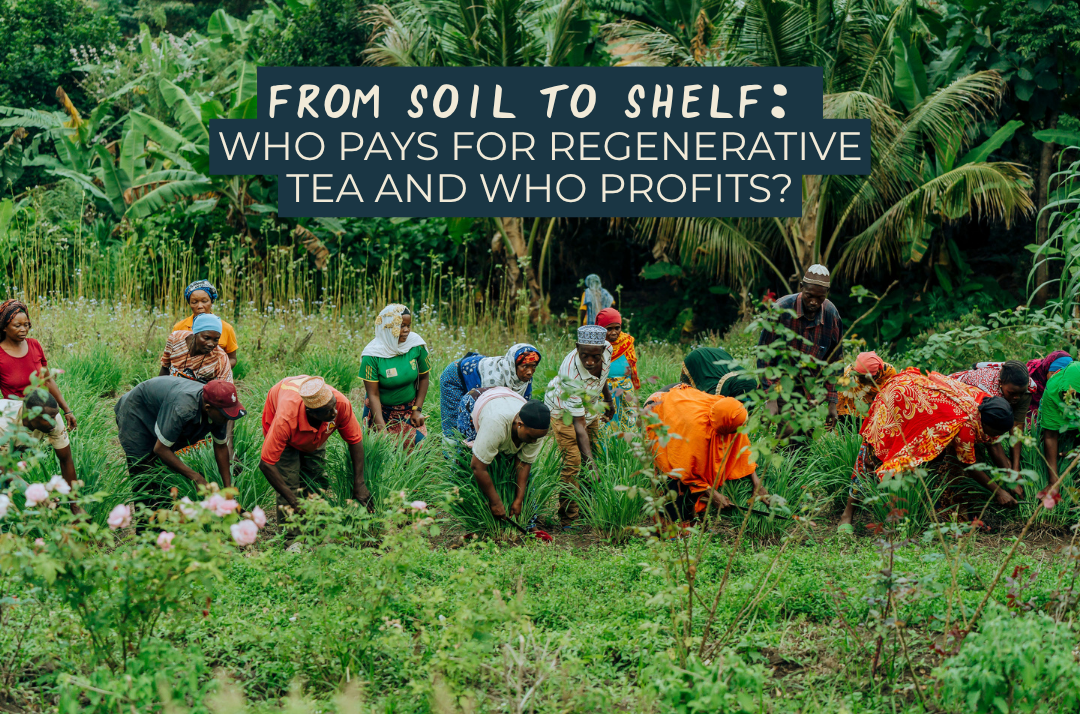
Right now, farms are in an incubation phase towards regenerative agriculture. Moving from traditional farming to regenerative systems is not free nor fast. Traditionally, farmers may rely on monocropping, synthetic inputs, and soil management that prioritises short-term production over long-term fertility. Regenerative agriculture shifts this toward rebuilding soil health through composting, mulching, crop diversification, intercropping, and integrating trees and natural pest control—requiring more knowledge, labour, and time before the benefits fully show up.
Kazi Yetu supports farmers on regenerative agriculture methods that we prioritize, such as intercropping chamomile within spice farms to support biodiversity and pollination, planting lemongrass as natural pest control along farm boundaries, and integrating trees such as acacia species that contribute to soil health and ecosystem balance.
If we succeed in this incubation phase, our farmers will have lower input costs, they would be independent of external inputs, their soil will have better water retention, crops will be more resilient, and nutrient cycling improves. Overall, there would be more stability of yields, despite climate change effects.
This incubation phase to sustained regenerative agriculture could last 3 to 5 years, depending on the crop and context, and it is the most fragile phase. Without support, many farmers simply cannot afford to stay the course.
So the question becomes: who pays for this incubation?
The cost of transitioning to regenerative agriculture is mostly absorbed upstream by producing and sourcing companies - businesses like Kazi Yetu that are directly invested in building long-term, resilient supply chains. These companies carry the burden of training, aggregation, early-stage inefficiencies, and market development.
At the same time, philanthropic and catalytic capital plays a critical role. Grants and donor funding help de-risk this incubation phase, where systems are being built but are not yet economically self-sustaining.
Kazi Yetu is fortunate to collaborate with strategic partners and donors, including Care International, Bloomberg Philanthropies, Biovision Foundation, Doen Foundation, AlphaMundi Foundation, KfW Development Bank, and others who share this vision and contribute towards the incubation phase.
But it would be a mistake to assume that philanthropy alone should carry this shift.
In reality, regenerative agriculture should be financed through a blend of capital:
- catalytic funding to support early incubation
- producer investment (like ours at Kazi Yetu) to build and manage the system
- and, crucially, market demand that sustains it over time.
This leads to the second question: who profits?
In the long term, the goal is clear: farmers must profit. Once regenerative systems stabilize, input costs can decrease, soil health improves, and diversified income streams emerge. Under the right conditions, this leads to more resilient and sustainable farmer incomes.
But this outcome depends on one critical factor: whether the market recognizes and rewards this value.
In short:
Regenerative agriculture is often framed as a win-win. In reality, it is a time-shifted investment across the value chain:
- Short term: costs are high, risks are real, and capital, philanthropic and commercial, must absorb them;
- Medium term: systems stabilize, efficiencies improve, and dependency on external inputs decreases;
- Long term: value is created, but only if markets reward it.
One may assume that if philanthropic capital supports the initial transition, regenerative systems will naturally become cheaper over time, and pricing will adjust accordingly. However, regenerative agriculture involves a rebalancing of value across the supply chain. Encouragingly, we are seeing that markets are evolving. Across many categories, there is growing recognition of quality, traceability, and sustainability as integral components of value.
At Kazi Yetu, we have experienced this firsthand. As we’ve built our regenerative sourcing systems, we’ve seen strong alignment from customers who value not just the product itself, but the system behind it.

Follow us on Instagram and Facebook to see our journey in action, and shop our regenerative agriculture tea & botanicals now.